
Index to Newspaper Articles
Dorset Echo – 8 August 2022
New accessible playground unveiled at Lulworth Castle
by Oliver McManus
A NEW children’s playground has been unveiled at Lulworth Castle.
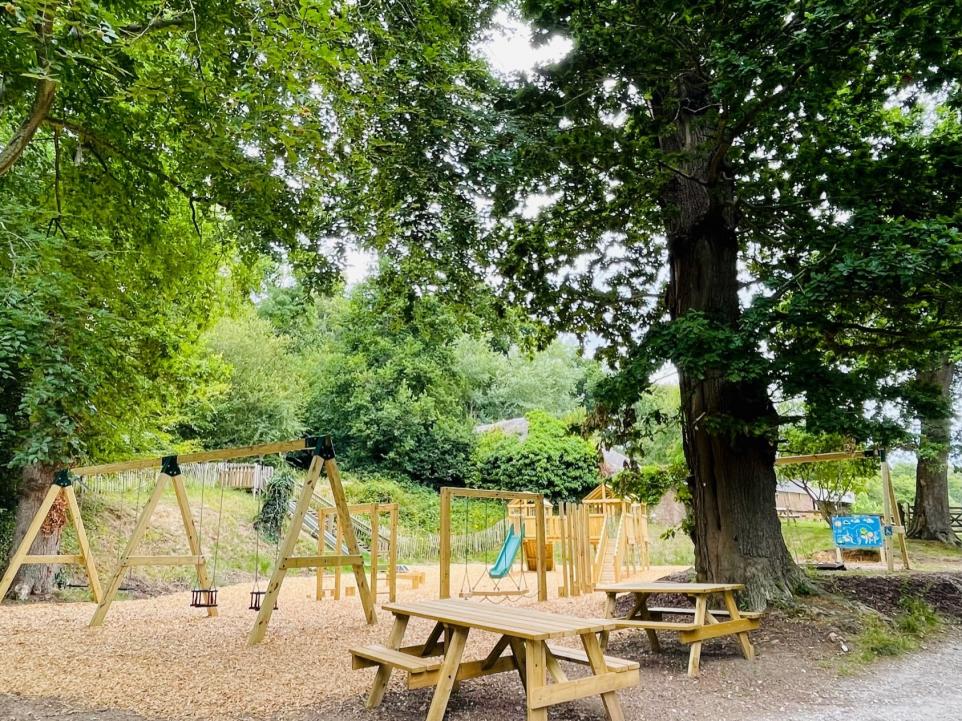
The woodland playground has had a complete makeover and renamed ‘Peacock Park’ – with rope bridges, swings, slides and monkey bars to keep the little ones entertained over the summer.
A sensory board and wheelchair-accessible swinging platform have been added to ensure as many children can get involved in the fun as possible.
The peacocks at Lulworth Castle, in Wareham, are getting set for some new additions with six Peahens from Brownsea Island joining the flock later this summer.
A spokesperson for Lulworth Castle said: “We look forward to welcoming them to Lulworth Park and hope they’ll enjoy their new home”.
Lulworth Castle is open Sunday to Thursday from 10.30am until 5pm with car parking costing £3 for the whole day.
For more information contact info@lulworth.com
Index to Newspaper Articles | Main menu
Dorset Echo – 15 April 2022
The Dorset Blind Association Motor Show returns to Lulworth Castle
by Kayleigh Heckford
A POPULAR motor show that attracts thousands will return to Lulworth Castle this year to raise awareness and money for the Dorset Blind Association.
After a two-year hiatus due to the pandemic the Dorset Blind Association Motor Show invites owners of classic, sport and super cars to the showground which features alongside a family fun day that’s open to the public.
The event, the only motor show held on the Lulworth Estate, has proved extremely popular with public and car owners alike and has sold out in previous years.
Olivia Akam, who drives a 1964 Morris Minor Convertible, said: “This is a splendid and well thought out event, and I’m so glad to see its return.
“We love that we can relax by our cars in such a beautiful setting. The tour for the Classics is through beautiful countryside, and the event provides so much for so many… a great family day out and for a great cause. I look forward to polishing the car for this one.”
For owners of classic, sport and supercars the show kicks off with a 20-mile ‘Dorset Tour’ through the local countryside before returning to Lulworth Estate to join the showground display.
The showground, which is accessible free of charge, will offer live entertainment, a kids’ fun area, food stalls, a beer tent and local craft stalls.
James White, Head of Brand at Hendy Group, said: “We’re very excited to be part of the Dorset Blind Association Motor Show for 2022. We’ll be bringing along a range of vehicles to the show from our Toyota, Lexus, Renault and Dacia brands.
“If you’re in the market for a car or simply want to explore the range available, we invite you to come along and speak to our product specialists.”
The event takes place on Sunday September 18 with the showground opening free of charge to the general public at 11am.
For those bringing a vehicle and wanting to be a part of the Dorset Tour and showground display the cost is £12 per person. This includes tour entry and information, showground display, breakfast roll and hot drink at registration and exclusive entry to Lulworth Castle.
Registration opens at 9am with the tour starting at 10.30am. Booking in advance is essential.
For more information call 01202 712865, email fundraising@dorsetblind.org.uk or go to https://dbamotorshow22.eventbrite.co.uk
Index to Newspaper Articles | Main menu
Dorset Echo – 24 December 2015
The head of Dorset’s Lulworth Estate, Wilfrid Weld, has died aged 81.
by Rachel Stretton
Mr Weld, who is head of the Weld family and owner of the Lulworth Estate, died on Tuesday, December 3 in Tahiti, after being taken ill while travelling with his wife Sally.

In a statement the Lulworth Estate said it made the announcement ‘with great sadness’.
Stephen Baynard, chariman of the Weldmar Hospicecare Trust, said: “The Board and staff of Weldmar Hospicecare Trust mark with deep regret the passing of Wilfrid Weld, one of our Vice Presidents and the son of Joseph Weld after whom the hospice in Dorchester is named.
“Wilfrid, and Sally his wife who was for many years a Trustee and is also a Vice President, have been tireless supporters of Weldmar hosting many events and contributing with the utmost generosity their time, wisdom and energy to the cause of better end of life care for people in Dorset. We send Sally and her family our deepest sympathy.”
Mr Weld is credited with transforming the Lulworth Estate into a tourism-led business and, in the process, helping to make the Durdle Door the iconic landmark it is today.
He was also involved in a number of local organisations.
A spokesperson from the estate said: “The Lulworth Estate is one of the UK’s finest, privately-owned estates and has been owned by the same family since 1641.
“Wilfrid Weld led the transformation of the Lulworth Estate from a traditional landed estate, into a modern and self-supporting business powered by tourism and agriculture.
“Under his leadership he restored the great Lulworth Castle and established Lulworth Cove and Durdle Door as iconic, internationally-renowned landmarks.”
Mr Weld was president Dorset County Cricket Club, Dorset Master Thatchers, and the Dorset Blind Association. He was president of the Dorset Gardens Trust, and its first chairman in 1989.
In addition, he was vice-president of the Dorset Wildlife Trust and a patron of the Catholic Children’s Society in Plymouth, of Headway Dorset and of Hampshire County Cricket Club.
The Weld family have owned and managed the Lulworth Estate since 1641, but the estate itself can trace its heritage back to the 11th Century.
It was traditionally an agricultural estate, but underwent diversification to be one of the first to recognise regional tourism, opening its doors to visitors in the first part of the 20th century when a holiday park, parking and coastal footpaths were established.
The World Heritage Site status was awarded by UNESCO in 2001 and the site was formally opened by the Prince of Wales in 2002.
The funeral will be held at 12pm on Tuesday, January 5 at Lulworth Castle Chapel. The family have requested no flowers.
Index to Newspaper Articles | Main menu
Dorset Echo – Monday 15 October 2012
Warm welcome for our new Rev
by Emma Walker
RESIDENTS of Lulworth, Winfrith and Chaldon flocked to a church to welcome a new member.
The Bishop of Salisbury, the Right Reverend Nicholas Holtam, licensed the Reverend Nicola Coleman to be the Priest in Charge.
A full congregation filled Holy Trinity church in West Lulworth for a welcome service.
It included 35 people from Ms Coleman’s former congregation at Holy Innocents, South Norwood in the Croydon diocese.
Jeremy Selfe, the benefice secretary, said: “A special hymn was sung to wish the new member good fortune as she and her family make the transition from an urban to a rural lifestyle.
“A warm welcome was given to Ms Coleman who was raised in a small Somerset village and knows Dorset well.”
Leaders of the local community were invited to play a part in the service on behalf of the benefice.
These included representatives from a nearby primary school, the Roman Catholic and Methodist churches, the Lulworth Army camp, the local farmers and businesses as well as the parish, district and county councils.
After the keys of the church were handed to Ms Coleman by the Archdeacon of Dorset, the Venerable Stephen Waine, the eager new member tolled a bell to mark the start of her ministry. A formal procession closed the service.
Index to Newspaper Articles | Main menu
The Purbeck Gazette –
Lulworth Estate Prepares for 2012
Lulworth Estate is preparing for 2012 by signing up to the Daily Echo and Weymouth and Portland 2012 Operations Team ‘Bring on the Games’ Campaign.
The Estate, which includes Lulworth Castle, Lulworth Cove and Durdle Door and its Holiday Park welcomes more than 600,000 visitors a year. For the sailing events it will provide the nearest cliff-top vantage point with an overview of Weymouth Bay.
“2012 presents a once in a lifetime opportunity for the area. Being so close to the action, we want to do our bit towards an all-round success”, explained James Weld of Lulworth Estate “Our staff have been briefed on the opportunities and responsibilities that come with an event of this scale and they will be kept abreast of developments from the 2012 Operations Team. It’s about making sure visitors, many of whom will be new to the area, have the best possible experience.”
Staff on the estate have also been asked to think of ways to capture the spirit of the occasion such as adopting ‘The Look’ by using the Olympic colours in flower beds and floral displays.
Local businesses were also invited to join the briefing held at Lulworth Castle. “The presenters inspired us with their enthusiasm and I left feeling really excited about the Olympics. I have since been telling friends and neighbours all about it”, said Avril Dale from Gatton House Bed and Breakfast in West Lulworth, “We too hope to add to the street scene by using Olympic colours in our summer planting”.
To find out more about the preparations for 2012 and how you can become involved please go to www.london2012.com/weymouth-and-portland
Index to Newspaper Articles | Main menu
Financial Times – Friday 2 December 2011
Dead interesting
By Lucy Kellaway
The popularity of ancestor worship means people are willing to pay thousands for a tailor-
The low sun slants through the windows of East Lulworth church in Dorset. Outside, sheep graze. Yet I’m oblivious to sun and sheep: all I can think about is a baby called Amos.
The hold this infant has on me is odd, given that half an hour earlier I’d never heard of him. Even now, all I know is written on a piece of paper that has just been pressed into my hand. It is a photocopy of the parish record and halfway down, in copperplate handwriting, it says that Amos Kellaway was baptised here on Christmas day 1831. His mother is listed as Elizabeth Kellaway, spinster. There is no mention of a father.
I look at the entry and feel wonder tinged with sadness. But I’m also taken aback to find myself feeling this way about my illegitimate great-great grandfather. This wasn’t the point of the expedition at all.
Six months earlier, I’d been invited on a tour of my roots arranged by Ancestral Footsteps, a travel company that organises tailor-made holidays for those who are too rich, or too lazy, to investigate their own family history. Set up in 2008, it works globally and its clients pay an average of £25,000 – the fee includes up to six months of research as well as a luxury tour of their roots. I had accepted the invitation gladly, not because I had any particular interest in my forebears, but because I wanted to understand the bizarre modern craze of ancestor worship.
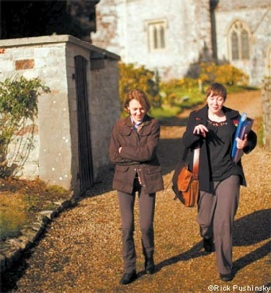
Ancestors are huge. Ancestry.com, the biggest database of the dead, has nearly 1.7m paying subscribers across websites in nine countries, and a database of 7bn digitised historical records. The craze is biggest in the English-speaking world but it is growing in popularity everywhere. People in Germany, India and China have started stalking their ancestors too.
Genealogy tourism, combining holidays with ancestor hunts, is on the rise. A study last year by the University of Illinois argued that the trend was the fastest-growing sector of the travel market, and a response to our consumer-driven lifestyle – a search for connection and authenticity in an inauthentic world. Maybe. But I think there’s a more obvious and less high-minded cause at work, too: the runaway success of the BBC reality TV programme Who Do You Think You Are? Originally aired in 2004, the eighth series of the show was shown this autumn. The format, which has been copied in 12 countries including the US, involves a famous person finding his or her roots and then breaking down on finding that a distant relation was a deserter, a villain, a hero or a murderer.
I’ve always found the show slightly vulgar, even though I can see it’s good celebrity TV, and has a nice bit of social history thrown in. It was bad enough to have chat show host Richard Madeley wringing his hands with guilt because an ancestor killed some native Americans in 1675. But to have Jeremy Paxman, who stands for rationality and rigour, in tears about his poor relations in Suffolk was really too much.
Even the name of the programme is a sham. Who we actually are is a matter of our own personality, luck, circumstances, education, and that of our parents. It isn’t to do with a story dredged up by a clever TV producer that happened to one wing of the family a long time ago.
Ancestor scepticism is in my blood. When I told my dad I was going on a genealogical holiday, he groaned, as I knew he would. When I asked my sister if she’d like to spend two days in a chauffeur-driven car with our own personal researcher tracing Kellaways, she answered with an emphatic “No”. I wasn’t surprised: we were brought up to dismiss people who were obsessed with family trees. For a start, it’s boring. Any sentence that begins with “my great-great uncle” is never going to go anywhere interesting. But we also saw it as pathetic. People should try to make something of themselves, rather than piggy back on the fact that a distant and long dead relative was a prince or a prisoner.
When I put these thoughts to Sue Hills, the founder of Ancestral Footsteps and a former producer on Who Do You Think You Are?, she merely smiled and said that people loved finding connections in their lives. Then I told her everything I knew about the Kellaways, which didn’t take long. My father was born in Australia, son of a doctor who died before I was born. I knew two things about him: he discovered a treatment for snakebite and he died of lung cancer. Dad’s grandfather, who my dad never met, was a clergyman. I didn’t know anything else about him at all.
I asked my father why and when his family had moved to Australia and he had no idea. Instead, he quoted something his father used to say to him: “It’s more important to be an ancestor than to have them.”
With such scant information, Hills went away to research my family. And I went away to research other people researching theirs.
In the crowded upstairs room at the National Archives at Kew in south-west London, every desk is occupied by a person of retirement age staring at a screen in a sort of rapture. They are poring over microfiches containing names of dead people, with a focus more intense than any I’ve ever seen in any other library, or anywhere else at all.
I interrupt the woman nearest me and ask in a whisper what she’s up to. “I’ve found a naughty boy,” she says, eyes popping. She tells me she’s just discovered that her great-grandfather’s brother had been convicted for stealing a £5 cart horse from the local parish schoolmaster. Her voice gets louder as she recounts this disgraceful tale, until a member of staff comes up and tells me to ask questions elsewhere.
Downstairs in the canteen, an elderly woman with a despondent air eats a tuna sandwich. She tells me she has spent three days a week for the past 17 years tracing her family but has failed to turn up anything interesting. “I haven’t got any exciting ancestors. They are all farm labourers and carpenters. I sometimes wonder why I keep doing it.”
So why does she?
“It’s an addiction. I can’t stop. You open one bit, and that opens something else. It is never finished.”
At another table, a retired married couple are looking at a folder they are assembling for their grandson (whom I fear won’t care one way or another). They also admit to being addicted and spend every morning at home on the internet and the evenings at family history groups at the local library. Today they have come to Kew to look at an ancestor’s naval records. “They give a description of him. We know how tall he was! It’s like having a hit of caffeine,” she says.
“Or something stronger,” her husband corrects her.
After visiting Kew, I realise I’ve got it all wrong. Ancestor stalking isn’t about making yourself seem grander or more exotic. The fun isn’t in the facts (which are boring), it’s in the hunting. Which I think may spoil my tour, as all the hunting has been done for me.
Somewhat oddly, my personal researcher knows much more about my family than I do
A few months later I get an email from Ancestral Footprints saying that the research into my family is complete, that great mysteries and excitement await. I’m told to go to Wareham in Dorset; I arrive late and tired at the ancient Priory Hotel, order a plate of cheese in the bar and go to bed. In the morning I meet my “personal researcher”, Jo Foster. She is a Cambridge history graduate who works part-time on the TV programme but has spent much of the past few months becoming a Kellaway expert. (It’s slightly odd that she knows much more about my family than I do, or it would be odd if I thought of them as my family, which I don’t.)
With a flourish, she hands over my great-grandfather’s death certificate but I don’t find it especially exciting as I can’t read the curly writing. So Foster explains that it says Alfred Charles Kellaway, clergyman, died at 73 in Australia, the son of Amos and Jane. He was born in Dorset and had lived in Australia for 66 years.
I feel vaguely let down to have discovered so easily when the family went to Australia. Foster tells me not to worry. There are good secrets coming. Indeed, the Kellaways are apparently more interesting than many of the celebrities whose family histories proved too dull to broadcast. Already, such flattery is working: I’m slightly more inclined to claim my dead relatives, after all.
Foster then shows me the marriage certificate of my great-great grandfather, Amos, who married Jane Smith in Pimlico, London, in 1856. Under profession, there is another word I can’t read. Foster reads it for me: cheesemonger. The plate of cheese I ate the night before swims unbidden into my mind. I push it firmly away.
Outside the hotel, our sleek chauffeur-driven car waits. As we glide through Thomas Hardy country, Foster hands me her laptop and asks me to Google the 1861 census. She tells me to type in my great-grandfather’s name, and there I “find” him. That year, Alfred Charles Kellaway is four years old, living in Swanage, Dorset, in a house with a family of fishermen. Against his name it says “boarder”. There are no other Kellaways in the house. Where are Amos and Jane?
Further census searching quickly finds Jane Kellaway. She is listed as a cook at the rectory in the same town. I feel relief that she is alive and glad she’s near her son. Of Amos, there is no trace at all.
We have just arrived at Swanage, a sweet seaside town, and the car pulls up outside the stone rectory. There are no cooks inside, separated from husbands and sons. Instead, a man in a Barbour jacket cuts his grass.
Foster tells me we are going further back in history to find out more about Amos, and thus we have come to East Lulworth church.
Perhaps it’s the fact that Dorset looks timeless and ravishing in the sun. Maybe it’s the detail of Amos Kellaway’s Christmas day baptism, or the illegitimate thing but, as I touch the cold, stone font I find I am, if not quite ready to cry, thoroughly bitten and smitten.
The next stop is Dorchester record office, where three pieces of paper await us. The first is a removal order. Dated 1829, two years before Amos was born, it orders the eviction of Charles Kellaway (shepherd) and 10 children (of which Amos’s mother was one) on the grounds that they had no right to poor relief there. The parish was sending them to nearby East Lulworth instead.
The second document is a bill, headed “Re: Kellaway – a pauper” and lists the legal expenses of the case – amounting to £24, 15 shillings and 8 pence altogether, showing that solicitors fleeced their clients then, as they do now. The third piece of paper showed that East Lulworth was so desperate not to be saddled with the poor Kellaways that it appealed against the decision but lost. At least I didn’t weep seeing these documents. I laughed.
We drive to nearby Cerne Abbas where the naked chalk giant looks down on the bucolic scene from which the Kellaways were cast out. I’m trying to resist the modern urge to apply psychobabble to Amos’s disappearance. Being born into such a marginal existence, who can forgive him for later abandoning his wife and child?
But what actually happened was rather different. An earlier census record found by Foster lists “sea” as the calling of Amos Kellaway. Further research finds him in ships’ records, and reveals him to have been 5ft 6in with hazel eyes. I read this greedily, now understanding the pleasure of the woman at Kew when she found out the height of her ancestor.
Foster asks me to type “HMS Iris” and “Amos Kellaway” into Google. And there the mystery is solved. My great-great-grandfather deserted ship in Sydney in 1857 to go in search of gold. He didn’t find any. But he found New World riches of another sort. After six years in Australia, he had made enough money as a farmer for Jane the cook and their six-year-old son Alfred to sail out to join him.
Their story ends happily ever after. The boy gets an education and becomes a clergyman. His son, my grandfather, becomes a doctor, finds a treatment for snakebite – and loses all interest in his roots.
My story ends happily, too. I tell my father and my sister about the pauper Kellaways in beautiful Thomas Hardy country. They swallow the story hungrily, along with a big side order of humble pie.
And so who do I think I am? The truth is that I’m not who I thought I was six months ago. I still maintain that who I am does not include impoverished shepherds or illegitimate deserting sailors and failed gold diggers. Time has washed them away. But it does include something less expected. Who I am now is a born-again ancestor bore.
Lucy Kellaway is the FT’s management columnist
© THE FINANCIAL TIMES LTD 2011 FT and ‘Financial Times’ are trademarks of The Financial Times Ltd.
Index to Newspaper Articles | Main menu
Dorset Echo –
Pub chimney fire tackled in East Lulworth
FIREFIGHTERS dealt with a blaze at a pub in East Lulworth last night.
Wareham crews were called to The Weld Arms at 6pm where there was a chimney fire.
They checked the thatched roof to make sure the fire had not spread.
Index to Newspaper Articles | Main menu
Dorset Magazine –
James Weld: Keeping it local
Lulworth Estate’s James Weld doesn’t need to log on to one of those burgeoning ‘trace your ancestors’ websites to find out what skeletons lurk in his family’s cupboard; his family has a long and well-recorded history that can be traced back at least as far as the 16th century. The Welds aren’t aristocrats but they are ‘old money’ and, needless to say, they are ‘landed’. In fact, the lovely estate that is Lulworth was acquired by one of James Weld’s ancestors back in the early 17th century, not as was often the case, through royal gift, but as a result of trade and business done in London. Today the estate is itself a business and like many old family estates, in modern times that business is based not just on agriculture, as was the case in the past, but is very diverse indeed.

Recently I met James Weld, the man who heads up that business, and I began by asking him to tell me something of his early years. He was born in 1960. He has two brothers and five sisters. James was educated at the Catholic school in East Lulworth, Farleigh House in Hampshire, Downside, and the Royal Agricultural College, Cirencester, where he did a year reading estate management. “Around this time I went off to Australia on a single ticket with £200 in my pocket,” James informs me. “I did various jobs on farms, in vineyards, and installing kitchens, though I did draw the line at washing-up!”
Back in England he joined Savills as a land agent and gained his letters with the Royal Institution of Chartered Surveyors before going on to set up his own business as a land agent in Salisbury. In 1993 he took over running the estate, an estate that has gone from having 45 people on its staff when he took over, to employing some 200 today. “We have 12,000 acres, 9,000 of which are farmland, 4,000 of which we farm ourselves,” says James. “There are more than 170 houses on the estate, most of which are let to staff at around half the going rate. I believe that people are the single most important asset of any business and that it is important to keep things local and seek out ways of employing as many people in the countryside as possible.”
Farming, then, is very important at Lulworth but more than 60% of the estate’s turnover comes from revenue generated by other enterprises. With the Durdle Door Holiday Park, Lulworth Cove, the Castle, shops, pubs, property management, outdoor events, gigs, civil marriages and wedding receptions, conferences, team building and banquets, Lulworth, the company, the brand, has done what a lot of farming-related businesses have been urged to do in recent times and that is diversify. With Lulworth, though, it has to be said that they have done it big time and done it very successfully indeed.
I put it to James that heading up a business as multi-faceted as Lulworth must be somewhat demanding. “It’s a hard job,” he tells me. “I never really stop work but then I always think I’m lucky to be doing my hobby as a job. I’m certainly not a worrier. I go home after work and I don’t find it in the least bit difficult to fall asleep!”
I ask him about outside interests. “We, that is my wife Sara and I, have three sons – Joe, 17, Oly, 13, and Guy, 10 – so as you can imagine, much of my life outside work revolves around the family. We have holidays, though often I can only manage to get away for a week at a time. I enjoy boating, I’ve got a RIB that is great fun, and I do quite a bit of shooting in the winter. I am Chairman of the Jurassic Coast Trust, an independent registered charity which is governed by a board of trustees, which aims to inspire people to appreciate and enjoy the Jurassic Coast and to safeguard it for future generations.”
Listening to James, I cannot help but be aware that here is a man who is doing what is obviously a very demanding job but who nevertheless manages to do it with a light touch. “I aim to make sufficient money to protect the estate and to ensure its future, of course I do,” James says. “But it is also about keeping the local community intact. I certainly don’t see myself as some sort of toff; if anything I see myself as the boss of a medium-sized company.”
Finally, I am keen to know what really annoys this easy-to-like, thoughtful, at times funny, at times serious, man. “Litter. I hate the stuff,” is his succinct reply. It is the answer of someone who loves the bit of England that his family has called home for some 400 years.
Visit www.lulworth.com and www.jurassiccoasttrust.org for more information on the Estate and the Trust.
Index to Newspaper Articles | Main menu
Dorset Echo – Tuesday 14 December 2010
More jobs to go on Lulworth estate
By Laura Kitching
SEVEN more jobs are set to go as part of cutbacks by the Lulworth Estate, while staff at a pub face an uncertain future.
Now 24 permanent staff at Lulworth Castle face redundancy, as the estate prepares to close several attractions and scrap several events.
The latest figure announced by the estate has risen from the previous estimate of up to 15 job cuts.
Seasonal employees will also be affected by the decision to close the café, shop and animal farm on December 31.
In a double blow for the small village of East Lulworth, staff at the estate-owned Weld Arms say they are also affected by the shake-up.
Weld Arms head chef Darren Paul said: “The pub is up for lease so they’re getting rid of the pub and hoping someone else will come in and take it on, without it having to close. I’m leaving next week to go to London because I didn’t know where I stood and two other chefs are leaving next week.
“There’s around 10 to 12 full and part-time staff here. It’s a shame this is happening because the pub has a reputation for good food.”
An estate spokesman said: “The Weld Arms is trading as normal and we’re currently taking Christmas bookings. The plan is to keep it open. A couple of staff are taking other jobs but no one’s being made redundant, it’s their own choice.”
Last month, the Weld family, who own Lulworth Castle and estate, announced plans to axe popular events like medieval jousting and the egg hunt. They blamed falling visitor numbers and unfavourable ‘economic prospects’, which had made it ‘impossible to justify further investment’.
The shake-up will leave 142 remaining staff on the estate.
The estate spokesman added: “There will be 24 job losses in the Lulworth Estate in general.
“That includes eight in the works yard and 16 across the café, shop and office staff.
“There are employees here who do have estate cottages but there will be no evictions. Housing is offered to all Lulworth employees at a heavily subsidised rent.
“There are four people potentially affected, with rent being reviewed after six months depending on the circumstances at that time.”
Councillor Graham Hemsley, chairman of East Lulworth Parish Council, said: “It’s a very tight little community. The loss of these jobs will be felt really keenly.
“The estate is a substantial employer around here, one can appreciate the situation that they didn’t get the throughput into the park this year they were expecting and obviously they can’t carry on losing money.”
A Lulworth resident, who did not wish to be named, said former employees with tied cottages to the estate had been told that their rent would go up to market rate in six months.
Index to Newspaper Articles | Main menu
Dorset Echo –
Lulworth Castle helps to boost Echo toy appeal
By Catherine Bolado
WITH less than four weeks until Christmas the Echo Toy Appeal has received a boost of presents and toys from Lulworth Castle.
Lulworth Castle is the home of the Weld family and they have donated presents and a cheque for £100 to the appeal to ensure that underprivileged children in Dorset have a happy Christmas this year.

Now in its eleventh year, the Echo Christmas Toy Appeal makes sure that children in Dorset have a present to open on Christmas morning.
There are 23 shops, supermarkets and toy stores across the county that are acting as collection points for gifts and so far the response has been good and with less than a month to go, the appeal is in full swing.
Sally Weld said: “As president of the Dorset branch of the NSPCC, I am well aware of the hardships faced at Christmas time for some families, especially in relation to buying presents. We have lots of young visitors to Lulworth Castle and they have the time of their lives here.
“It is always a pleasure to see the youngsters enjoying themselves, which is why we wanted to donate to the Echo Toy Appeal, it is a really great idea and we are very happy to support this worthwhile cause for the second year running.”
The toys and gifts collected will be added to the donations by readers.
As part of the Christmas Toy Appeal the Echo is encouraging businesses to get involved with the 20 for 2010 campaign. The campaign is looking for 20 companies to donate £100 each to the appeal.
This money will go to top up the funds raised by the appeal and help to ensure that every child that has registered for a present will receive one.
Any businesses wishing to get involved should contact the Toy Appeal office on 01305 830815.
Vouchers for the toy appeal can be sent to the Dorset Echo Toy Appeal at Fleet House, Hampshire Road, Weymouth, DT4 9XD.
The Dorset Echo on the Granby Industrial Estate in Weymouth and Antelope Walk in Dorchester are also accepting donations of toys, games and arts and craft materials for the appeal.
Please only donate new, unwrapped presents and please no cuddly toys.
Index to Newspaper Articles | Main menu
Daily Echo –
Up to 15 jobs to go at Lulworth Castle
By Catherine Bolado
UP to 15 jobs could be lost at Lulworth Castle after it was announced that the estate is to close several attractions and scrap several events.
Popular events like mediaeval jousting and the egg hunt will go amid financial pressures at the estate at East Lulworth.
Yesterday the Weld family, who own Lulworth Castle and estate, announced that the café, shop and animal farm would close on December 31.
Approximately 15 jobs will face the axe but the family said that they did not know the exact figure yet and would try and retain as many staff as possible to work on different parts of the estate.
The family said that the jobs losses were due to falling visitor numbers and unfavourable ‘economic prospects’ that would ‘make it impossible to justify further investment’ in the estate.
Speaking about the decision James Weld said: “The family are very disappointed to have to take the decision to reduce our activities at Lulworth Castle and the direct effect that this will have on those people who are being made redundant at a difficult time.”
He added: “We have continued to support this part of our business for the last 12 years but the economic prospects over the next few years, make it impossible to justify further investment.
“Everyone involved in Lulworth Castle and Park has worked extremely hard but it has become increasingly clear that we are not going to achieve the visitor numbers necessary to continue the business in its current form.”
One Lulworth resident, who did not want to be named, expressed shock at the news.
She said: “It’s come as a bit of a surprise and it’s quite shocking really. Several people around here work on the estate and have ties to it.”
The animal farm area is home to a variety of animals including rare Portland sheep, peacocks, alpacas, goats, pigs, rabbits, guinea pigs, ducks and chickens. These will all now be re-homed.
Outside events, including weddings and the award-winning family festival Camp Bestival, will go ahead and the castle and grounds will be available for hire for corporate parties and events.
The castle will also be open for members of the public to look around but popular events including the jousting, historic combat festival and pirate-themed events will go from January 1, 2011.
Lulworth Castle’s Christmas events will still run from December 19 to December 31 and there will be a host of traditionally themed attractions including stories by the fireside, magic shows, games and quizzes. There will also be a chance to see how traditional mince pies were made in the castle kitchens.
Index to Newspaper Articles | Main menu
Daily Echo, Monday 31 August 2009
Lulworth Castle exhibition will recall a fateful day
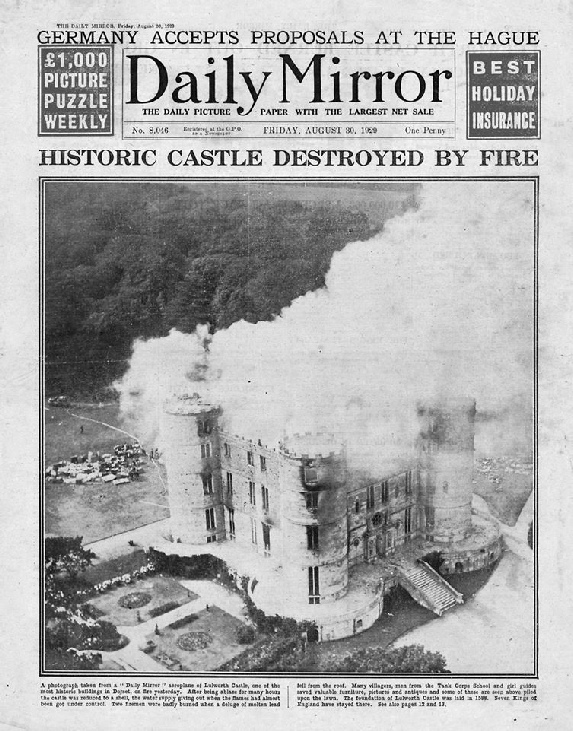
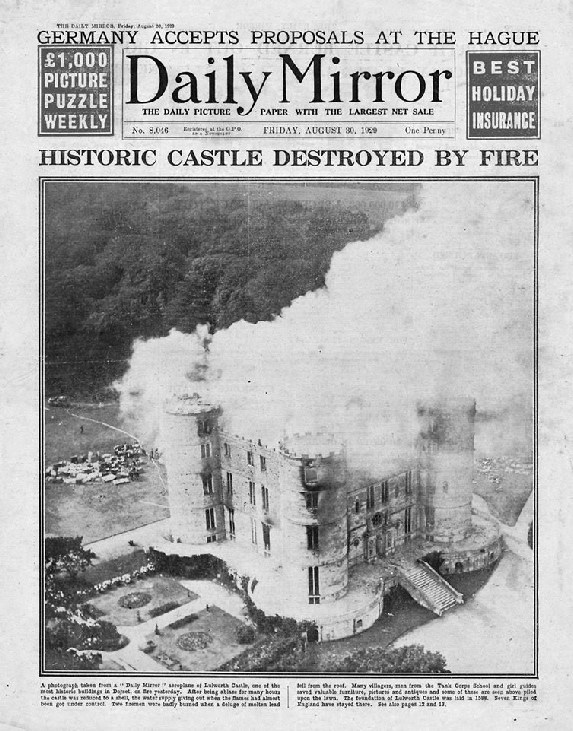
MEMORIES of the fire that devastated Lulworth Castle 80 years ago are going on show for the first time.
Over the years Sally Weld, whose family owns the estate, has been collecting memorabilia about the disaster in anticipation of putting the exhibition together.
She said: “We are delighted to be able to open this new exhibition to commemorate the 80th anniversary of the fire, which savaged this beautiful castle.
“As part of the castle’s history, it is a great way to relive the shocking story of what happened over those heartbreaking few days and to remember the castle as it used to be.”
The fire was first detected on the morning of August 29, 1929, by a housemaid, when she smelt smoke and heard cracking glass.
Herbert Weld, castle owner at the time, tried to fight the flames, but could not put out the fire.
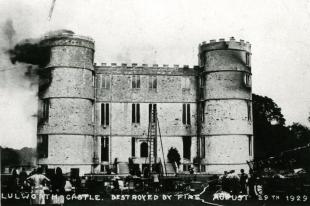
Firefighters from Dorchester, Weymouth, Poole and Swanage all tried in vain to tackle the roaring blaze, but by late afternoon the water supply ran out – they even tried to get water from the sea, but did not have long enough hoses.
After three days the fire died down, leaving the castle a ruin.
The exhibition includes items found during the restoration works, as well as press coverage and eyewitness accounts from villagers, 1930s fire-fighting equipment, a period fire extinguisher and brass firemen’s helmets.
The cause of the fire was never determined, but Herbert Weld believed that it was probably due to a fused wire in the store room where it broke out.
It would be another 70 years before the castle, after being restored by English Heritage, was reopened to the public, on March 31 1998.
Index to Newspaper Articles | Main menu
Daily Echo –
On the march as army base reopens path
WALKERS were given a new perspective on the Purbeck countryside and coast as a Lulworth footpath was reopened after 70 years.
The ancient path from East Lulworth to Arish Mell was closed to the public in 1938 as the army expanded its firing ranges.
But 70 years on the Lulworth Estate and the army have joined forces to clear the land and reinstate the footpath, which offers dramatic views of the World Heritage Jurassic Coast.

James Weld, from the Lulworth Estate, said: “We are delighted this walk will be reopened to the public and welcome all walkers to come and tread the path for the first time in more than 70 years.”
“The last time this route was used by the Estate was in 1929 when the fire service attempted to draw water from the Arish Mell Gap to extinguish the devastating fire at Lulworth Castle.”
Access to the reinstated route will still be restricted to specific times, but the path will connect the main coastal path to East Lulworth and the walks through the Lulworth Estate.
It starts just outside the walls of Lulworth Castle and meanders for about a mile down to the coast.
Index to Newspaper Articles | Main menu
Daily Echo –
WALKERS stepped forward to test out a coastal footpath opened for the first time in more than 70 years.
The 1.5km path, leading from East Lulworth to Arish Mell, was reinstated after the Army joined forces with the Lulworth Estate.
The estate held an opening ceremony to mark the occasion and declared over 50km of pathways across its land open to the public.
Lieutenant-Colonel Charlie Lambert joined landowner James Weld to welcome the first group of ramblers onto the route.
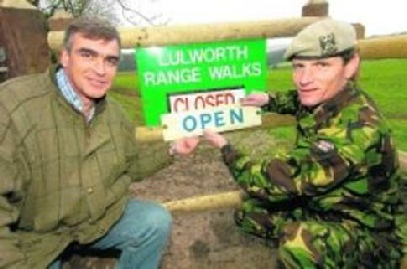
Picture: GRAHAM HUNT
Mr Weld said: “We are delighted this walk will be opened to the public and welcome all walkers to come and be the first to tread the path for over 70 years.
“This, in addition to the Army Range Walks, offers a dramatic view of the Jurassic Coast through the most beautiful countryside.”
The last time the route was used by the Lulworth Estate was on August 29, 1929, when firefighters tried to draw water from the Arish Mell Gap to put out a blaze at Lulworth Castle.
Mr Weld, chairman of the Jurassic Coast Trust, said he hopes walkers will treat the path with respect.
He added: “Walkers are reminded to respect this delicate environment, remain on the path and to take all their litter home with them.”
The coastal route will be open until January 2 and will then be open at selected times.
Marketing manager Trudy Braithwaite said: “We’re encouraging everyone to come down over the Christmas period and walk off some turkey.”
Index to Newspaper Articles | Main menu
Daily Echo – Thursday 21 June 2007
By Juliette Astrup
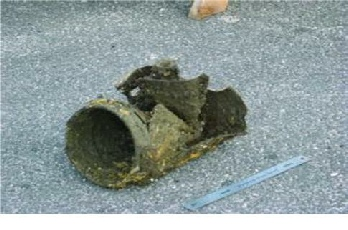
A SECOND World War bomb found at a Purbeck pub was so big it had to be moved by experts before they could carry out a safe explosion.
The 50kg, 18in-long device lay untouched for more than 60 years beneath drinkers’ feet in the garden of The Weld Arms, East Lulworth.
It is the third unexploded device to be discovered at the pub since the war. The first fell in the landlord’s bedroom in 1944 and was recovered from under a sofa, and another was discovered in the roof in 1994.
The latest, and by far the largest, was uncovered by workers digging with a JCB on Tuesday afternoon.
The area was immediately evacuated and a team from The Royal Logistics Corps from Bulford Camp called in to assess the device. They requested the 33 Regiment Royal Engineers from Cambridgeshire who arrived yesterday morning.
The location and size of the bomb meant it couldn’t be exploded where it was in case it damaged the 17th century thatched pub.
Police imposed a 400 metre exclusion zone, and three homes were evacuated while the bomb disposal experts made the device safe.
It was then transported under escort to the AFV Gunnery School at Lulworth Camp, where it was detonated remotely at 3.15pm with a 1km exclusion zone.
Wilfrid Weld, owner of the Lulworth Estate where the pub is situated, said he recalled the day when the three bombs were known to have been dropped.
He said: “A returning German bomber was pursued by The Royal Air Force, when it discharged its load, with three devices landing on The Weld Arms. Two bombs have already been found and the third has now just been uncovered.”
Nick Kelly, property manager of the Lulworth Estate, said : “Every precaution was taken including sandbagging the area to mitigate any damage to the pub in the event of an explosion.”
He added: “That’s three out of three now – a full house, so hopefully it will be the last one.”
Inspector Ash Adams, who was at the scene, said: “The rural location was quite fortunate and meant we could deal with it with minimum disruption to the public.”
Index to Newspaper Articles | Main menu
Daily Echo – Wednesday, 20 June 2007
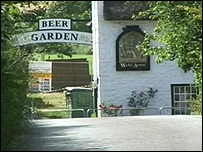
AN 110lb Second World War bomb was found in the beer garden of a thatched Dorset country pub, police said.
The partially buried German bomb surprised workers building a terrace in the garden at The Weld Arms on the Lulworth estate in Dorset yesterday.
The army bomb squad was called out from Tidworth, in Salisbury, and a 400 metre cordon was put in place around the thatched pub in East Lulworth, Dorset Police said.
The Royal Engineers, from Cambridge, were also called out and were making the bomb safe before moving it the MoD’s firing ranges in Lulworth for a controlled explosion.
The bomb, which is nine inches in diameter and two and a half feet long, has 110lbs of high explosives, a badly deteriorated fuse and is believed to be armed.
No-one was in the pub at the time which police said was in a ”secluded spot” with several unoccupied buildings nearby.
Index to Newspaper Articles | Main menu
BBC News – Wednesday, 20 June 2007
An unexploded World War II bomb discovered in the back garden of a village pub has been removed
The device – thought to contain 50kg of high explosives – was found outside the Weld Arms pub in East Lulworth, Dorset.
The pub and nearby homes were evacuated after the 2.5ft-long (0.8m) bomb was found by a man digging with a spade.
Because of the size of the device, bomb disposal experts decided to remove it to a military range near the village where it could be safely detonated.
A spokesman from Dorset Police said: “Due to the size of this unexploded bomb the Royal Engineers team from Cambridge could not actually do the explosion in situ as it could demolish the pub and surrounding houses.”
The team from the Royal Engineers in Cambridge transported the bomb by van at about 1430 BST to the military ranges at East Lulworth.
Index to Newspaper Articles | Main menu
Daily Mail –
Prince Harry’s secret love nest
By KRISTINA PEDERSEN
At army camp Prince Harry spends his time enduring a gruelling itinerary as he trains to be a tank commander.
And strict army officers ensure their recruits have no distractions – especially of the female kind.
So the cheeky Prince has worked out a way around the strict no women rule at his base-by renting a romantic cottage nearby.
The 21-year-old has sourced the £1,500-a-week love nest, which is a 15 minute drive away from the camp at Bovington, Dorset.
Zimbabwean girlfriend Chelsy Davy has stayed with him ‘several times’ since arriving in England after finishing her exams in Cape Town last month.
But although the cottage, hidden in a tree-lined field is discreet in terms of location, its name is rather less subtle.
Called Shaggs, the title has provided a source of amusment for his peers.
A fellow recruit told The Sun: “Harry insists he had no idea what the place was called when he decided to rent the cottage. He’s taken a real ribbing, but he sees the funny side now.”
He added: “We know what he gets up to when he stays off camp, so what better place to stay than Shaggs?”
Clarence House have confirmed Harry has accommodation away from Bovington.
Index to Newspaper Articles | Main menu
Country Life –
Lulworth Castle, Dorset
By John Goodall
Lulworth Castle has opened its doors to the public again
Fifty years after a disastrous fire in 1929 left the building a gutted shell, Lulworth Castle has once again been opened to the public, but in a rather surprising form. In a combined conservation initiative between English Heritage and its owners – lasting nine years and costing about 5 million pounds – it has been turned into a roofed ruin. Externally, this appears as it did the day before the fire, but the interior remains essentially untouched, scorched and with the bare bones of the fabric exposed. The recent conservation work has generated a great deal of information about the development of the building and allowed the first accurate reconstruction of its original seventeenth -century internal plan. The early history of Lulworth suggests that its remarkable design, with its trappings of defence, illustrates the continued popularity of the castle as a residence beyond the Middle Ages.
Opening Times: 28 March – 31 Oct, 10am – 6pm. 1 Nov – 25 March, 10am – 4pm. Admission: Adult £4.00, Child £3, Conc. £3.50.
Location: In E Lulworth off B3070. 3m NE of Lulworth Cove.
Index to Newspaper Articles | Main menu
Daily Echo –
Celebration of Lulworth
TRAGIC soldier-poet Rupert Brooke called it “the most beautiful place in England”; Hardy was a regular visitor and Keats spent his last happy day on English soil clambering over its rocks.
The exiled King Charles X of France held court at the Castle and it was long believed that Napoleon himself once stole ashore in the Cove to check its suitability as a starting point for an invasion of England.
Today, we know it as one of the Dorset coast’s most popular tourist attractions with its crammed car park, visitors bottlenecked to the sea along Main Road and then scattered over the stony beach and cliff faces in the Cove itself.
Lulworth – whether East, West, Castle or Cove – can still spark the imagination and with due cause according to a new book celebrating the famed Purbeck villages.
The Book of Lulworth* charts Lulworth’s lengthy history from the formation of the spectacular geological grotesques at Durdle Door, Stair Hole and Dungy Head; to the foot-and-mouth outbreak of 2001.
The book is littered with the robust names of the coast’s many features – Hambury Tout, Bull Rock, Bat’s Head, Man o’ War Cove, Scratchy Bottom, Arish Mell – but, as ever in such histories, the most fascinating episodes involve the ordinary folk of the villages.
Farming, fishing and smuggling form a large part of the story of their lives and there is no shortage of tales.
Illustrative artist Molly Brett, whose work appeared in Enid Blyton’s books, captured the eight-year-old Brian O’Hare showing his prowess with a shrimp net in the 1930s. Somewhat more seditiously, the Lulworth Millers were known as both great fishermen and great smugglers and these family traditions were proudly upheld, apparently with the tacit approval of the local gentry and landowners.
Another common factor in bringing small, rural communities to life is the faintly benevolent presence of a little myth and mystery. Lulworth has its Phantom Army seen marching across what are now the Army firing ranges in 1678. Legend has it the appearance of a ghost army is the presage to a war, but the Monmouth Rebellion did not flare up for another seven years. Even in recent times, fog-shrouded ghostly forms have been spotted, and according to the spinster Loader sisters, who collected folklore for West Lulworth WI in 1932, on nights such as these “no rabbits run and no dog will go near”.
Lulworth soil has been trodden by royalty many times since James I became the first ruling monarch to visit. Charles II fled the Great Plague of 1665 to take refuge at Lulworth Castle; while Maria Anne Smythe, widow of landowner Edward Weld, went on to marry the Prince of Wales – later George IV. The wedding went ahead without the consent of King George III (himself a visitor to Lulworth) and was duly declared invalid as the Prince was married off to Princess Caroline of Brunswick. Not that his dalliance with Maria was to end, the couple relaunched their most public affair shortly after the marriage.
And the villages continue to exert their charm on visitors and locals alike. Comic actor Arthur English recalled his posting to Lulworth as an instructor at the Armoured Fighting Vehicles School: “It’s nice to think the boys at Lulworth still remember me,” he said. “A lot of water’s passed under the bridge since I was there – some of it pretty chilly. But I don’t have to run to Wool to catch the passion wagon to Bournemouth any more; and it seems a long time since I had a pint in the Castle.”
The Book of Lulworth by Rodney Legg, £19.95, Halsgrove. ISBN 1 84114 141 0
Index to Newspaper Articles | Main menu
The Observer –
Millions were in germ warfare tests
by Anthony Barnett, Public Affairs Editor
The Ministry of Defence turned large parts of the country into a giant laboratory to conduct a series of secret germ warfare tests on the public.
A government report just released provides for the first time a comprehensive official history of Britain’s biological weapons trials between 1940 and 1979.
Many of these tests involved releasing potentially dangerous chemicals and micro-organisms over vast swaths of the population without the public being told.
While details of some secret trials have emerged in recent years, the 60-page report reveals new information about more than 100 covert experiments.
The report reveals that military personnel were briefed to tell any ‘inquisitive inquirer’ the trials were part of research projects into weather and air pollution.
The tests, carried out by government scientists at Porton Down, were designed to help the MoD assess Britain’s vulnerability if the Russians were to have released clouds of deadly germs over the country.
In most cases, the trials did not use biological weapons but alternatives which scientists believed would mimic germ warfare and which the MoD claimed were harmless. But families in certain areas of the country who have children with birth defects are demanding a public inquiry.
One chapter of the report, ‘The Fluorescent Particle Trials’, reveals how between 1955 and 1963 planes flew from north-east England to the tip of Cornwall along the south and west coasts, dropping huge amounts of zinc cadmium sulphide on the population. The chemical drifted miles inland, its fluorescence allowing the spread to be monitored. In another trial using zinc cadmium sulphide, a generator was towed along a road near Frome in Somerset where it spewed the chemical for an hour.
While the Government has insisted the chemical is safe, cadmium is recognised as a cause of lung cancer and during the Second World War was considered by the Allies as a chemical weapon.
In another chapter, ‘Large Area Coverage Trials’, the MoD describes how between 1961 and 1968 more than a million people along the south coast of England, from Torquay to the New Forest, were exposed to bacteria including e.coli and bacillus globigii , which mimics anthrax. These releases came from a military ship, the Icewhale, anchored off the Dorset coast, which sprayed the micro-organisms in a five to 10-mile radius.
The report also reveals details of the DICE trials in south Dorset between 1971 and 1975. These involved US and UK military scientists spraying into the air massive quantities of serratia marcescens bacteria, with an anthrax simulant and phenol.
Similar bacteria were released in ‘The Sabotage Trials’ between 1952 and 1964. These were tests to determine the vulnerability of large government buildings and public transport to attack. In 1956 bacteria were released on the London Underground at lunchtime along the Northern Line between Colliers Wood and Tooting Broadway. The results show that the organism dispersed about 10 miles. Similar tests were conducted in tunnels running under government buildings in Whitehall.
Experiments conducted between 1964 and 1973 involved attaching germs to the threads of spiders’ webs in boxes to test how the germs would survive in different environments. These tests were carried out in a dozen locations across the country, including London’s West End, Southampton and Swindon. The report also gives details of more than a dozen smaller field trials between 1968 and 1977.
In recent years, the MoD has commissioned two scientists to review the safety of these tests. Both reported that there was no risk to public health, although one suggested the elderly or people suffering from breathing illnesses may have been seriously harmed if they inhaled sufficient quantities of micro-organisms.
However, some families in areas which bore the brunt of the secret tests are convinced the experiments have led to their children suffering birth defects, physical handicaps and learning difficulties.
David Orman, an army officer from Bournemouth, is demanding a public inquiry. His wife, Janette, was born in East Lulworth in Dorset, close to where many of the trials took place. She had a miscarriage, then gave birth to a son with cerebral palsy. Janette’s three sisters, also born in the village while the tests were being carried out, have also given birth to children with unexplained problems, as have a number of their neighbours.
The local health authority has denied there is a cluster, but Orman believes otherwise. He said: ‘I am convinced something terrible has happened. The village was a close-knit community and to have so many birth defects over such a short space of time has to be more than coincidence.’
Successive governments have tried to keep details of the germ warfare tests secret. While reports of a number of the trials have emerged over the years through the Public Records Office, this latest MoD document – which was released to Liberal Democrat MP Norman Baker – gives the fullest official version of the biological warfare trials yet.
Baker said: ‘I welcome the fact that the Government has finally released this information, but question why it has taken so long. It is unacceptable that the public were treated as guinea pigs without their knowledge, and I want to be sure that the Ministry of Defence’s claims that these chemicals and bacteria used were safe is true.’
The MoD report traces the history of the UK’s research into germ warfare since the Second World War when Porton Down produced five million cattle cakes filled with deadly anthrax spores which would have been dropped in Germany to kill their livestock. It also gives details of the infamous anthrax experiments on Gruinard on the Scottish coast which left the island so contaminated it could not be inhabited until the late 1980s.
The report also confirms the use of anthrax and other deadly germs on tests aboard ships in the Caribbean and off the Scottish coast during the 1950s. The document states: ‘Tacit approval for simulant trials where the public might be exposed was strongly influenced by defence security considerations aimed obviously at restricting public knowledge. An important corollary to this was the need to avoid public alarm and disquiet about the vulnerability of the civil population to BW [biological warfare] attack.’
Sue Ellison, spokeswoman for Porton Down, said: ‘Independent reports by eminent scientists have shown there was no danger to public health from these releases which were carried out to protect the public.
‘The results from these trials will save lives, should the country or our forces face an attack by chemical and biological weapons.’
Asked whether such tests are still being carried out, she said: ‘It is not our policy to discuss ongoing research.’
Index to Newspaper Articles | Main menu
Dorset Echo –
Celebrity launch for new butterfly charity HQ
GREEN-FINGERED celebrity Alan Titchmarsh visited East Lulworth to open the new headquarters of national charity, Butterfly Conservation.
It is the largest insect charity in Europe and aims to save wild butterflies, moths and their habitats.
The charity headquarters were formerly based in Colchester and have been merged with a team of 11 conservation staff in Dorset.
Chief executive David Bridges said: “Butterfly Conservation is delighted to have moved its headquarters to Dorset.
“It is the first time the society has had a combined headquarters and it will improve communication among the staff.”
Index to Newspaper Articles | Main menu
Bournemouth Evening Echo, Thursday 9 September 1993
Villagers rally to restore church
VILLAGERS at East Lulworth have already raised £28,000 towards the restoration of their historic church.
The village has rallied round the appeal after successfully beating off a threat that the church, which is listed as a grade two building, would be closed.
The fund raising has been achieved by the village which has a population of only 150 people and a regular congregation of between 15 and 18, with 30 at festivals and up to 80 at Christmas.
Purbeck council has now approved making a three year loan of £2,250 to the parish church of St. Andrew towards the work.
The restoration appeal for the 15th century church is now into its third year.
Earlier this summer organisers of the appeal revealed that the fundraising effort was likely to continue into the future.
The main problem at the church is the ravages caused by damp. Repairs have been estimated at £86,000. This is much more than the appeal organisers had expected.
Grants have been offered towards the work totalling more than £43,500 from English Heritage, the Talbot Village Trust, the Dorset Historic Churches Trust and the Manifold Trust.
The church boasts a 500 year old tower, although the nave and the chancel, as they now exist, date from Victorian times.
At one time the village of East Lulworth would have been clustered around the church, which is set near the castle and the historic Roman Catholic chapel. The village, however, would have moved away from that site during the enclosures of the 1700s.
The appeal’s chairman Keith Lewis has said ‘What is so good is that the community has come together to work together!
Index to Newspaper Articles | Main menu
The Times –
Discharge by pipeline in Dorset
GENEVA, Sept. 11 – Four Harwell scientists reported at the conference that mildly radioactive waste from the new atomic station at Winfrith heath, Dorset, could be discharged safely into the sea from an underwater pipeline two miles off the Channel coast in a diluted form and provide no hazard to the public.
The projected underwater pipeline would begin at Arish Mell, about 10 miles east of Weymouth, after the effluent had been pumed underground from the station, said the report.
One problem was a shoreward drift off Arish Mell which would return some of the “much diluted” waste toward the coastline. “While the drift may seem a disadvantage,” the report said, “it does ensure a greater dilution because of the resultant circulation around the whole bay and also diminishes the chance of a local build-up of radioactivity at the end of the pipeline or anywhere in the area.” Later, when the tide turns west, the diluted effluent would be swept out to sea.
Investigations showed that the discharge could not harm the general public through bathing in “active” sea water, lying or walking on adjacent shores, handling contaminated fish, using seaweed – for example, as a fertiliser – swalowing “active”sea water or sand, breathing “active” sea spray or dust from the shore.
To see a film about the laying of the pipeline, go to our Arish Mell page
Index to Newspaper Articles | Main menu
The Times –
ROYAL TANK CORPS RANGES
The Secretary of State for War, represented by Mr. L.C. Marrow, solicitor, applied at Swanage (Dorset) County Court for immediate possession of premises occupied by Mrs. B.K. Davis, Seavale Farm Cottages, East Lulworth, which, it was stated, were required for the extension of the Royal Tank Corps ranges. It was stated that the need for possession was urgent. There was a claim of £2 19s 10d., arrears of rent and mesne profits, but Mr. Marrow stated that the Minister was prepared to waive that if he could obtain immediate possession. An order for possession in two weeks’ time was made by Judge E Watkins Cave K.C.
Index to Newspaper Articles | Main menu
FIRE.
LULWORTH CASTLE.
THE CONTENTS SALVED, BEING THE PERSONAL PROPERTY OF HERBERT J. WELD, ESQ.,
AND NOW REMOVED TO THE GRAMMAR SCHOOL, DORCHESTER.
MESSRS.
H. GOULD & CO., LTD.,
HAVE RECEIVED INSTRUCTIONS FROM THE ASSESSORS ACTING ON BEHALF OF THE INSURANCE COMPANIES CONCERNED
TO SELL BY PUBLIC AUCTION AT THE GRAMMAR SCHOOL, DORCHESTER
THE CONTENTS COMPRISING THE
FURNISHINGS OF THE RECEPTION ROOMS.
SPANISH AND ITALIAN CABINETS, CHIPPENDALE, SHERATON, AND OLD ENGLISH FURNITURE IN MAHOGANY AND OAK, CLOCKS, BRONZES, ORIENTAL AND CONTINENTAL DECORATIVE CHINA, LINEN, DOMESTIC CHINA, GLASS AND EFFECTS INCLUDING GRAND PIANAFORTE IN EBONIZED CASE (BY BECHSTEIN)
ON WEDNESDAY AND THURSDAY, NOVEMBER 6TH AND 7TH, 1929, COMMENCING AT 11 O’CLOCK A.M. PRECISELY.
ON VIEW MONDAY AND TUESDAY PRIOR TO SALE.
FOR FURTHER PARTICULARS AND CATALOGUES APPLY TO THE AUCTIONEERS:-
Messrs. H. GOULD and CO., LTD., 12, WILSON-STREET, FINSBURY, LONDON, E.C.2.
TELEPHONE BISHOPSGATE 4122
The Times, Saturday 19 October 1929
The Times, Monday 2 September 1929
Lulworth Castle Fire
Renewed outbreak quickly extinguished
Fire broke out again at 9 o’clock on Saturday morning at Lulworth Castle, the Dorset seat of Mr. Herbert Weld, the interior of which was destroyed by fire on Thursday. The renewed outbreak occurred in the part of the castle containing the strong room. The Dorchester fire brigade was called out again, and was able to extinguish the fire in a few minutes.
Lulworth Castle was visited on Saturday by thousands of visitors from Bournemouth, Weymouth, and other parts of Hampshire and Dorset. They were disappointed in finding all the entrances guarded and barred by sentries from the Royal Tank Corps and admission was refused. In many cases visitors climbed over the walls to get a view of the ruined castle, but were soon turned off by soldiers.
Military sentries were also posted to guard the premises containing tapestries, books, and other treasures salved from Thursday’s fire, which are at present stored in the village and in the two village halls. A survey of the castle will, it is expected, be made to-day.
Index to Newspaper Articles | Main menu
Daily Mirror – Friday, 30 August 1929
The Times –
Mansion in ruins
Lulworth Castle burned
Art treasures saved
(from our special correspondent)
Wareham, Aug. 29
Lulworth Castle, the residence of Mr. Herbert Weld, an historic 16th-century mansion just west of Purbeck Hills and overlooking the sea between Portland Bill and St. Alban’s Head, has been reduced to a skeleton by fire. The stone exterior, built in the form of a cube, with a circular tower at each angle, and its fine ornamental front, with allegorical statues of music and painting and stone figures of two Romans in uniform, are still standing, pathetic features of the now derelict mansion which has given shelter to kings. Late to-night the fire was still smouldering in the basement of the castle, and it will probably continue to do so for some hours. Members of the Royal Tank Corps are guarding the building.
Ever since the castle was built at the end of the 16th century it has been in the possession of the Weld family. It contained many heirlooms, including portraits by Lely, and valuable furniture, But although the mansion has been gutted, the flames having has a free run owing to lack of water, Mr. Weld told me to-night that he believed most of the important pictures and the old furniture, as well as the books in the library and the plate, had been saved. The canopied bed in the King’s Room, in which King George III. slept, has been destroyed, but what is considered to be the greatest artistic loss is the destruction of the beautifully decorated ceilings of about the year 1770.
The discovery
The castle, which stands in a large park, was of four storeys. On the first floor were the library, drawing-room, and dining-room. Above these were the King’s room and the principal bedrooms. On the top floor, where the fire broke out, were other guests’ rooms and servants quarters.
When the outbreak was discovered shortly after 9 a.m. Mr. Weld joined the servants and estate workpeople in their efforts with the aid of fire extinguishers to prevent the flames from spreading. Workers formed a line up the staircase from the ground floor to the top storey, and buckets of water were passed up and poured on the fire, but the smoke was so dense that Mr. Weld and those with him had to retreat. The fire still appeared to be in one section of the fourth floor. By this time the whole village of Lulworth had been roused and fire brigades summoned from Dorchester, Swanage, Weymouth and Poole. Before their arrival workers on the estate and villagers began to save the contents of the mansion.
The Dorchester brigade was the first to arrive, shortly before 11 o’clock. Mr. A. R. Jeffrey, chief officer of the Dorchester brigade, and firemen wearing smoke helmets made their way to the roof immediately above the fire. The roof was of lead, and was concealed from view by battlements. With some difficulty a hosepipe was got up and was turned on to the flames through the roof. The fire had still failed to cover the whole of the top floor, and there were hopes that it might be prevented from spreading. Then, at the critical moment, the water ceased to flow. It had been pumped from a large tank in the garden, which soon became exhausted. A supply of water was next obtained from a well a few yards from the mansion. The brigades of Poole, Swanage and Weymouth had now arrived, as well as a sergeant and 14 men of the Royal Tank Corps who are stationed at Lulworth. They, with the villagers, the estate workers, and Girl Guides who were encamped in Lulworth Park, did valuable work in saving the treasures in the building.
The fire was still confined to the top floor, but was burning fiercely, and it was apparent that unless a larger volume of water could be poured on to the flames the buildings were doomed. The salvage workers had been forced to retreat from the third storey, but they continued their work below, and the lawns around the mansion were strewn with old furniture, books, paintings, and other art treasures. Efforts were made to save the King’s Bed before smoke and heat made it impossible to reach the third storey, but without success.
Pipeline to the sea
The supply of water from the well was still being poured on the flames, but this well also became exhausted. Part of the lead roof fell in, and the third floor became ablaze. Two members of the Dorchester fire brigade were slightly injured by molten lead and falling glass. Salvage work was still going on in the lower storeys, but water was now the great need. About two miles from the mansion is Arish Mell Gap, through which the sea can be seen from the terrace of the castle. The sea now appeared to be the only available source of supply, and between the mansion and the coast three fire engines were placed at intervals and a line of pipe was run into the sea, but all attempts to get sea water failed.
The King’s Room and the ballroom on the third floor were now blazing, and there was nothing to prevent the fire spreading. The flames issued from the windows of the circular towers and from all sides of the building. The task of removing the salved treasures from the lawns to buildings on the estate was carried on throughout this afternoon and evening. It was not until about 5 o’clock that the fire burned itself out. To-night there are beams in the building still smouldering, and some of the walls of the castle, owing to the damage they have suffered, have rents which give them a dangerous appearance.
Index to Newspaper Articles | Main menu
Western Gazette, 11 August 1876
SCHOOL TREAT
Thursday, August 3rd, was a day of much rejoicing in East Lulworth, being the school feast of the National School. The managers and friends of the school contributed most liberally, among whom we must notice principally E. L. Kindersley, Esq., Clyffe; Rev. N. Bond, Grange; Mrs. Kendall, East Lulworth Vicarage; Mrs. White, Burton; Mrs. G. Budden, Coombe; &c. The Wool Brass Band was in attendance, and headed the school children (numbering 73) in a procession round the village, which formed a very pleasing and happy sight, nearly every child carrying a banner with appropriate mottoes. After tea prizes were awarded to the 44 children who passed the Government examination, and books to the value of £1 5s were distributed. A most pleasant afternoon and evening were spent, and all thoroughly enjoyed themselves, under the excellent management and liberality of Mrs. Kendall. An excellent tea was provided by Mr. Lawrence, grocer. Before separating, the children heartily cheered the kind friends of the School, and their excellent and beloved mistress, Mrs. Trent.
Index to Newspaper Articles | Main menu
The Hampshire Advertiser –
Frightful Death
A melancholy accident happened on Thursday afternoon as some boys were searching for gulls’ nests on the craggy rocks which abound on the Dorset coast, near East Lulworth.
One of the lads, 15 years of age, named Loveless, perceived a nest on the ledge of a rock and while engaged in taking the eggs the stones upon which he stood were seen to give way and the poor boy was precipitated over a cliff of 5000ft in height on to the rocks below.
His mangled corpse was taken up and conveyed to the Weld Arms Inn, where an inquest was held on Friday before Mr. H. Lock, deputy coroner. The jury returned a verdict of “Accidental Death.”
[Henry Rolls’ Journal states ‘John Lovless, a boy of Kimpets End fell out of the cliff, highest part of Bendon Hill gitting gulls’ eggs on the 20th of June 1867.’]
Index to Newspaper Articles | Main menu
The Bury and Norwich Post and Suffolk Herald – Tuesday, 5 March 1867
Extraordinary discovery of a lost ring
Some two years ago a married woman at East Lulworth lost her wedding-ring in her domestic duties. A few days ago while she was peeling potatoes, and on dividing a sort of double potato she found in the inside of the potato the lost wedding-ring which she was able to identify. The potatoes were grown in a field some half a mile from the cottage, where it is supposed the ring had been carried in the manure, and the potato had grown through.
The woman is thought to have been Maria Roper.
Index to Newspaper Articles | Main menu
The Tablet –
An English Landlord
WAREHAM—TESTIMONIAL TO JOSEPH WELD, ESQ., OF LULWORTH.
The presentation of a splendid piece of plate to Joseph Weld, Esq., of Lulworth Castle, by his tenantry, took place on Monday se’nnight at the Weld’s Arms Inn, East Lulworth.
The dinner was an admirable one, and the company large and respectable, Mr. THOMAS RANDALL in the chair. Mr. Weld was represented by his son Edward, having himself been too ill to attend. After the usual loyal toasts, the CHAIRMAN rose and said—
It is with feelings of the deepest possible regret to myself, as I am sure it must be to you all, to witness the absence of our highly respected landlord, who we had hoped this day personally to beg the acceptance of a small tribute of our gratitude and esteem. But being aware that his absence is caused by circumstances over which he has no control, It is gratifying to find his representative present in the person of his son, Edward Weld, Esq., and whom it becomes my duty to address on behalf of those gentlemen who have placed me in this important position.
(Then, addressing Mr. Edward Weld).
Sir, the tenantry on the Lulworth Estates, being desirous of marking their high sense of the esteem and regard in which your venerable father is held amongst them, have assembled together this day, for the purpose of presenting him with a piece of plate, on which is inscribed the heartfelt expression of an attached tenantry.
Now, Sir, as a tenant of many years standing myself on the manor, I must be fully sensible of the various acts of kindness and attention your venerable father has manifested towards us, and the enumeration of them will be as pleasing to me to rehearse as I am sure it will be for you to hear.
First then, Sir, at a time of severe agricultural depression, occurring not many years ago, that circumstance being judiciously pointed out to him, by his excellent steward (our friend Mr. John Hyde), he nobly came forward to the assistance of the tenantry, and enabled them to hold that position in society to which they feel they have a right honourably to aspire.
Next, Sir, permit me to refer to a circumstance on which I speak with peculiar pleasure, I refer to a period when your father permitted all his tenants to expend a certain per centage on the rent, in the shape of artificial manures, the effect of which proved to be a powerful stimulant to further improvement and outlay on the part of the tenantry.
Again, Sir, some three years ago, our friend Mr. Hyde was requested to lay before your father the expressed opinion of the tenantry, that an alteration of the rent days from Christmas to Lady Day, and from Midsummer to Michaelmas, would be highly desirable and of considerable advantage, and to which proposition your father regardless of his own personal considerations, readily consented; and were it necessary, I could point to the state of the markets this season to prove the great advantage of the alteration and which all who are acquainted with the subject will, I am sure, readily concede.
One other act of kindness I must now mention; — your father’s attention being drawn by way of memorial to a great excess of game on some of his farms, he with great liberality and kindness of feeling, directed such changes to be made as to give the tenantry entire satisfaction. We consider this to be a great advantage, seeing that we have now all the world to cope with in agricultural matters, and with the removal of all real and practical grievances, we do not fear being able successfully to meet competition, come from what quarter it may. At the same time we would not interfere with the legitimate sport of the country gentlemen. On the contrary, we desire that whenever your father, yourself, or friends should visit the manor, you may find no lack of sport, and we pledge ourselves to use our utmost endeavour to maintain and protect it for you. On this point then, Sir, I trust I have said sufficient.
But I must not omit one other matter, and that is relative to rabbits, an animal I consider an enemy to the landlord, especially where draining is required, for one rabbit burrowing in a drain will throw the water back upon the whole frame of work, and thus leave the ground In a worse state than it originally was. To the tenant all admit they are an enemy, and also to the community at large from their destroying so large a portion of human food, for it is proved that in every three weeks of his existence, a rabbit eats and destroys more than the value of the carcase.
Thus, Sir, I have endeavoured to explain to you briefly, but faithfully, and to the best of my ability my own sentiments and those of my brother tenants on your father’s domain.
I now come to the most pleasing part of my evening’s duty. The tenants, as I have before observed, being desirous of marking their sense of the obligations enumerated, do most respectfully beg your father’s acceptance of this tribute of their respect, and which on their behalf I now present to him through you.
It has emanated from most unquestionable motives of sincerity, and from an united tenantry. Trusting that he and you, and all who are dear to you, may long live in the enjoyment of every privilege your high position necessarily commands, and that you may be blessed with every happiness both temporal and spiritual, is the sincere prayer of every individual subscriber, and doubtless of every person who has assembled to witness our proceedings this day. (Cheers.)
And now, gentlemen, I call upon you to rise and drink “Restored health and happiness to Joseph Weld, Esq.” (Drunk with three times three twice over.)
Mr. EDWARD WELD returned thanks in a voice and manner full of feeling. Be concluded with the following words : —
“It is indeed grateful for a landlord to receive such a mark of the esteem he is held in by his tenantry, and I am sure I may say that my father’s is a tenantry with whom any man may feel proud to be connected. It is, indeed, cheering in these times, when there are so many trying in different quarters and endeavouring to sow contention between landlord and tenant. It is cheering to see such good feeling as has been exemplified at this meeting. Gentlemen, do not believe those who tell you that the understanding which exists between landlord and tenant is a mere contract; I will point to that beautiful memento and say, this proves a complete contradiction. The contract between landlord and tenant, no doubt, is founded in the first instance on mutual interest and advantage, but I do say that man has no heart who does not feel an attachment growing stronger and stronger every day, when the tenantry unite in a bond of union so complete as that which evidently unites you, as a body, to your landlord. (” Hear,” and cheers.)
With respect to the question of game, I can only say that I rejoice to find that these concessions, and that disposition which my father evinced to meet your wishes, were satisfactory to you, and can only say, that they were equally satisfactory to him and to me. And, gentlemen, you have solved a problem which has of late been mooted in different places, and made use of as a handle to sow discord between landlord and tenant, for you have shown, in conjunction with your landlord, that the fair and legitimate enjoyment of the sports of the field are perfectly compatible with the wishes and requirements of the tenantry, and the state of agriculture as it exists at the present day. Gentlemen, I could dwell long on the subject, but I feel that I have trespassed considerably on your time — (“No, no,” and ” Go on) — but my heart was full, and I have to a certain degree freely given vent to feelings which I shall boast of to the latest day of my life. (Cheers.)
This beautiful piece of plate which you have presented, will be always present to our minds, to cherish and keep alive a warm feeling of attachment to the tenantry here; it will be handed down from generation to generation, and I shall teach my son to venerate, respect, and preserve it as your gift. (Loud applause.) I shall teach him that attachment to his tenantry should be the first and dearest feeling of his heart; for, gentlemen, these feelings I know are founded upon the noblest sentiments of our nature, and I rejoice that my lot is cast among you — that I have had an opportunity of being present at this most interesting occasion, and I can only repeat my best wishes for your health, your happiness, and your prosperity ; and as time rolls round, I sincerely hope that we may often meet the same happy faces here, and that we may all one day enjoy that more perfect happiness, which we can never have on earth.” (Loud and continued applause followed this excellent address.)
The tenants all spoke in Mr. Randall’s language, or at least with his sentiment.
The following was the steward’s (Mr. Hyde) speech. —
“I have had the opportunity of meeting you upon various occasions, for twenty years, and whenever those meetings have taken place, whether on pleasure or business, I am pleased to say I have endeavoured to do all I could for the tenants, at the same time that I did justice to my employer, and I bless myself on being so successful. I always found we were going on in good [t]une, and every year gaining union and strength between landlord and tenant. It is a great satisfaction always to see the landlord and tenant on a favourable and good understanding; and you may rest satisfied, as long as you remain on this property, as long as you do what is right and just to your landlord, as every honest man should do, you need not fear — ’tis in the blood of them and never can come out. (Cheers.) Act fair and honest, and you will always be supported to the end of the chapter. We like to get good tenants and to keep them; I never saw any profit attend shifting tenants; if I saw any mistake I rectified it if possible. To see such a body of men united in such good feeling (and I believe you have all a good feeling towards me) is extremely gratifying. I have used all my endeavours to keep the tenantry together, Nothing is so annoying as to be on unpleasant terms, and I know but of one unpleasant occurrence on the manor, consisting of more than a hundred tenancies, and I must say I felt much on that occasion, for it is not in my nature to feel comfortable while there is one man living whom I cannot meet as a friend.” (Cheers.)
The Lawyer who for thirty years had presided at Mr. Weld’s audits in Dorsetshire, Mr. Bartlett, was toasted with much regard, and made a speech as unlike that of a stage lawyer as Mr. Hyde’s was from the popular idea of a steward.
The health of the Rev. Mr. Bond, a neighbouring Clergyman, was then drank, and Mr. Hyde said he remembered having attended a meeting of that gentleman’s tenantry to do honour to their landlord in a manner similar to the celebration of that day, and that on that occasion Mr. Bond had proposed Mr. Weld’s health in a very handsome manner. He said that, in reference to the game, Mr. Weld had made great sacrifices in his concessions to his tenants; but, as regarded himself, there was no merit; he never was a sportsman, never carried a gun, and cared little about the sport. As for the Mr. Welds, they were all sportsmen, and the sacrifice on their parts was very different. The country round Lulworth had always been noted as a sporting country; the concession, therefore, was so much the greater, and the tenants were so much the more obliged.
The other speeches were all made in a corresponding spirit, and the happy party retired in measureless content and just before midnight.
Index to Newspaper Articles | Main menu
The Morning Post –
The Royal Family of France –
Poole, August 25
The Ex-King of France arrived at Lulworth Castle on Monday afternoon, landing near the mansion front one of the steam-packets granted for their use by our Ministry. A great number of persons were assembled on the beach and neighbouring heights in order to witness the approach and landing of the fugitives. Shortly after three o’clock two carriages arrived, with luggage and a few attendants, and about five o’clock two other carriages drove up the Park, containing the deposed Monarch, the Duke of Angouleme, the Duke of Bordeaux, the Duke of Luxembourg, and General Baron de Damas. The Ex-King was received at the entrance of the Castle by Joseph Weld, Esq. with whom he cordially shook hands, and immediately entered the Castle. The number of persons in front of the Castle at the time of their arrival did not exceed 200. Charles (who, we believe, now bears the title of Duke of Milan, being prohibited from residing in England otherwise than as a private individual), is of rather tall stature, but he does not display his figure to any advantage, owing to a rather ungraceful stoop. He bears evident marks of age, and appears somewhat weakened, but not so much as might have been expected in a man nearly seventy-three years of age, after the great anxieties and fatigues he has so recently undergone. There is a character of mild gracefulness about his countenance, tinged with a cast of melancholy. The Duke of Angouleme, his eldest son, who is fifty-five years of age, is much shorter than his father, and looks nearly as old as his father. The Duke of Bordeaux, who will be ten years old on the 25th of the next month, is a very fine and interesting child: he is tall for his age and possesses a countenance beaming with intelligence. The Princesses and the retinue did not arrive until the following day. As the whole of the suit cannot be accommodated at the Castle we hear that Heffleton House, occupied by the late Dr. Baines, has been taken during their sojourn in this country: and if that should prove still insufficient, it is rumoured that endeavours will be made to obtain Brownsea Castle. It is generally believed that their stay here will not exceed a month, an application having been made to the Emperor of Austria, for permission to pass through a portion of the Imperial territory, on the route to Dresden, where the abdicated King means to seek a permanent residence. – (Dorset County Chronicle.)
Index to Newspaper Articles | Main menu
The Morning Post – Saturday, 18 December 1824
H.R.H. The Duke of Gloucester at Lulworth
WAREHAM, Dec. 15 – On Sunday last, his Royal Highness the Duke of Gloucester attended divine service at the parish church of East Lulworth whose ancient pyramidical tower rising above the laurel groves that surround the spot where “Each in his narrow cell forever laid, The rude forefathers of the hamlet sleep,” proudly rivals the battlements of the adjacent palace.
It was one of those beautiful days, in which Winter, flinging aside his robe of clouds and storms, wreathes his hoary brows with a garland of sunbeams, and wins the idle wood-blast to breathe on its Æolian harp, a melancholy but melodious hymn to the morning. At the appointed hour the Church was filled with an attentive and devout assembly, and a choir from a neighbouring village attended, to assist by their harmonic powers in the service of the Sabbath, and pay an additional honour to his Royal Highness.
A number of parsonages are daily visiting his Royal Highness the Duke of Gloucester, at Lulworth Castle. His Royal Highness enjoys his shooting, and appears in excellent health.
As proof of the mildness of the season a white butterfly was seen on Sunday last sporting on the beautiful domain near Lulworth Castle.
Index to Newspaper Articles | Main menu
The Times – Wednesday 25 December 1822
Poachers
On Saturday night, the 7th instant, Mr. Hunt, head gamekeeper to the Right. Hon. Robert Peel, of Lulworth Castle, received information that a body of poachers intended that night to enter his master’s plantations. Immediately summoning his assistants, twelve in number, he awaited their arrival; and between eleven and twelve o’clock the discharge of several guns announced their near approach. Mr. Hunt, on challenging them, was answered by a person who appeared to act as leader, who said, “We are five-and-thirty strong, and are for death or glory; but we will not use fire-arms, unless your party fire first.” Turning to his men, he then threatened to shoot the first who left the field, and placing them in military array, a general fight ensued. Both parties were armed with clubs and swingels (instruments much used by poachers, and resembling flails). After a combat of 20 minutes, the poachers retreated, leaving behind them several pheasants which they had killed, but taking away the keeper’s valuable double-barrelled gun. Each poacher was distinguished by a white handkerchief round his hat. Mr. Hunt was much hurt, and all his men more or less bruised. An account being transmitted to Mr. Peel, Bishop, the officer, was sent down, and five of the poachers are in custody. Most of the gang lived 12 or 14 miles distant.
Index to Newspaper Articles | Main menu
Royal Cornwall Gazette 22 July 1820
Melancholy Event
It is our painful duty to record the calamitous intelligence of the death of Wm. Baring, of Lulworth Castle, esq. (brother of Sir Robert Baring) and the Rev. John Bain, rector of Wintreth, and only son of Dr. Bain, of Heffleton, near Wareham, in the county of Dorset. Having on the evening of the 9th inst. walked to the sea shore at Arish Mill, near the Castle, they were induced by the calmness of the sea to row out in a small boat belonging to Mr. Baring, which unfortunately upsetting, they were both drowned. This melancholy event becomes more afflictive from the circumstance of Mrs. Baring and the two Miss Bains accompanying them to the shore, and being eye-witnesses of the painful sight. While attempting to change places in the boat it upset within a hundred yards of the shore. The spring tides setting very strong off this rocky coast, probably prevented their being able to reach the shore. Mr. Baring was found in a short time, and every means used to restore animation, but it was too late. Mr. Bain’s body has not yet been discovered. Mr. Baring was married to Miss Thompson, the sister of Mr. Andrew Thompson, of the firm of Thompson, Bonar and Co.
Index to Newspaper Articles | Main menu
The Morning Post and Gazetteer –
Increase of Popery in Dorsetshire
…
If every convert made by Papists is the loss of a subject to the King, it surely is high time to put a stop to the increase of Popery in Dorsetshire. At East Lulworth, near Weymouth, Mr. Weld.has erected a Monastery, and established Monks. Almost the whole of the people there have embraced the Romish faith.
Index to Newspaper Articles | Main menu
Page last updated: 22 October 2022